Antenna Gain: Nothing Is Actually Gained
We routinely describe antennas as having “gain.” A dipole has about (1.64X) or 2.15 dBi of gain. A Yagi might have 3.2X (~10 dBi) and yet nothing is amplified. Perhaps we would understand antenna performance better if we talked first about directionality and only then introduced gain as a number used to quantify it. Antenna gain quantifies where the RF energy is going and where it isn’t.
Consider for the moment an ideal antenna that radiates equally in all directions. This hypothetical isotropic radiator spreads its power uniformly over an ever-expanding sphere. It has, by definition, a gain of 1, or 0 dB. The unit dBi means dB compared to an isotropic radiator.
If we feed 100 watts into an antenna, it cannot radiate 200 watts merely because it has 3 dBi (2X) gain. Conservation of energy hasn’t been suspended. What we call antenna gain is really a measure of directionality.
Suppose we reshape that radiation pattern by reducing the amount of RF going upward and downward while directing more of it along the horizontal. We haven’t increased the total radiated power; we have merely concentrated it into one direction at the expense of other directions. That’s antenna “gain”.
The doughnut-shaped radiation pattern of a simple dipole antenna sends maximum energy broadside its two radiating elements and very little off the ends of the elements. See figure 1 below.
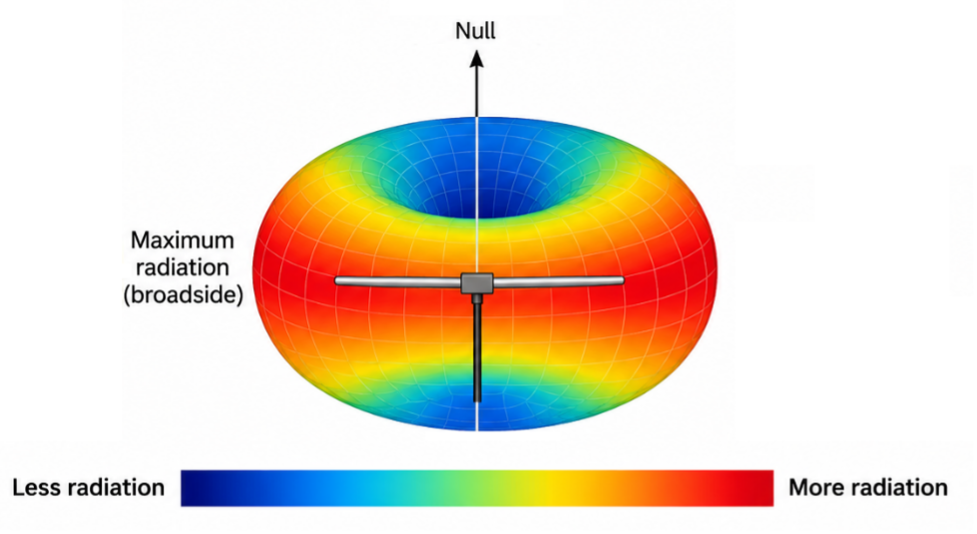
A beam antenna simply takes the idea further by adding passive elements to its structure to concentrate the RF energy in a preferred direction.
A Yagi antenna is a beam antenna, and it will concentrate much of its radiation into a relatively narrow region, or lobe, in the direction to which it is pointing. The angular width of that region is called beamwidth. The narrower and more concentrated the beam, the greater the antenna’s gain in that direction. This characteristic is a good reason to mount a Yagi on a rotator, to make best use of all its directional gain.
The gain associated with the antenna’s directionality works equally on transmit and on receive.
Questions or comments on antenna gain? Click here to Contact Us.
73 de VE7DQS
Last Updated on 2026-09-28 by Joannadanna