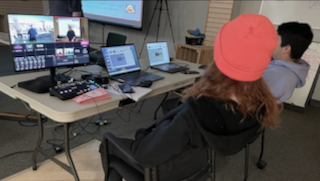
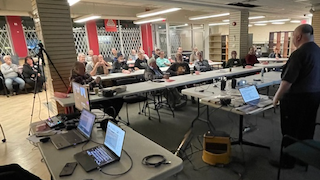
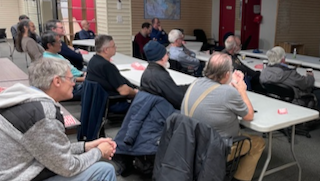
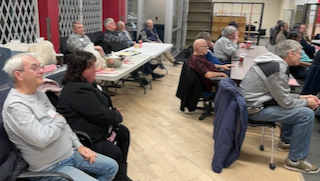
The January Monthly Meeting was well attended, both in person and online. There were two key presenters: Craig, VE3OP, and Bert, VA3PXE, and in the last segment, Roger, VA3EGY, provided updates on recent and upcoming activities. Read on to learn more about the meeting.
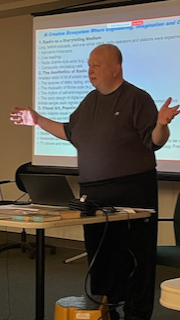
- Craig Delmage, VE3OP, delivered a distinctive presentation titled “Amateur Radio in Creative, Performing and Media Arts in Canada”.
This one-hour, media-rich, colourful presentation used graphics, pictures, audio clips and video to highlighted two national productions from 2025, in which Craig and several other local amateurs played quiet, supporting, yet essential roles. The talk had three sections:
A. “Requiem for Radio: Full Quiet Flutter (RFR: FQF)” at the National Arts Centre
RFR: FQF was a 60-minute live performance that followed the format of a traditional requiem, but for the thirteen demolished Radio Canada International (RCI) shortwave towers once located near the border of New Brunswick and Nova Scotia. From here, RCI transmitted shortwave radio around the world from 1944 to 2012. The performers on stage interacted with an elaborate set of invented and modified electronic instruments that used sensors, custom circuits, and wireless technology to play the ghosts of the radio towers with radio waves. Here is a link to the RFR: FQF page on the NAC website, and a related article title: Invented instruments summon ghosts of historic radio towers.
Craig’s presentation had the following structure: Overview, Artist(s), Supporting Radio Team, Timing / Effort, Historical Backdrop, Technology, Show, Challenges, and Rewards.
He covered the history of Radio Canada International and provided audio and visual highlights of RCI and the show itself.
B. Forthcoming Amateur Radio episode of the new Tom Green show
Craig talked about supporting the filming of Amateur Radio activities for the new “Tom Green Show” series that will be airing in 2026 on Crave TV. Again, his presentation had the following structure: Overview, Artist, Supporting Radio Team, Timing / Effort, Historical Backdrop, Technology, Show, Challenges, and Rewards. Craig covered the history of Tom Green and pictures of the the amateur team at work.
C. Craig’s personal reflections on radio and the arts
In the final section, Craig shared some thoughts on radio and the arts (encompassing media, performing, and collaborative arts), including the past 100 years and what’s in store for the near future involving AI. He brought some artifacts from his own amateur library to let others see and handle.
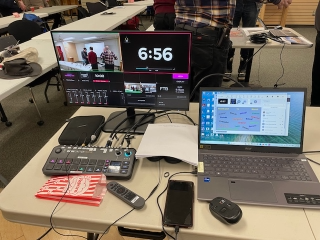
A big “Thank You” to Craig. It took him a month to put it all together! And everyone enjoyed the popcorn.
- Bert, VA3PXE, conducted an informal poll on possible workshop topics
Based on a list of possible workshops drafted by Roger, Bert polled meeting participants to gauge the level of interest of each one. The poll was conducted by way of a show of hands, and online participants also contributed their opinions.
The list of topics appears below with the number of interested people in square brackets at the end:
- Build a 1/4 wave 2M Groundplane Antenna – that can be installed on a mast (to improve your signal at home) [2]
- Build a Roll-up 2M J-pole Antenna – that can be thrown up into a tree or pushed up on a telescopic mast for portable operations using an HT or Mobile radio (good up to 25 or 50 watts). Ideally buy all the components and sell as a low-cost kit. [4]
- Build a 2M tape-measure yagi antenna – that can be used for fox hunting or where directional signal is required to reach another station or repeater. [4]
- Build an offset attenuator – that can be used with your tape-measure yagi and HT for fox hunting [3]
- Build a Meshtastic/Meshcore Companion radio [7]
- Build a MeshCore Repeater including waterproof enclosure, higher capacity lithium battery and solar panel [5]
- Plan/Build a Pico Balloon, launch it and tracking it. [7]
- Build a HamClock node using a Raspberry Pi and learn what all the data means [7]
- Setup FT8 on your HF radio and laptop and learn how to make contacts and log them to obtain awards [3]
- Learn how to install, configure and use
N1MMLogging software for contesting [8] (not just N1MM) - Build a multi-band HF End-Fed antenna [9] (was only 7 when originally narrowed to half-wave)
- How to configure your DSTAR radio to get on our new repeater [9]
Additionally, participants are interested in:
- Soldering course at a time other than Sunday morning [3]
- Microwave radio [1]
- DMR [5] Norman potentially leader?
- Cable building [2]
- Different radio makes / models exposure
If you missed the meeting and would like to indicate which workshops you would be likely to attend, click here to Contact Us and let us know.
Keep your eye on the OARC website for more information as the Club narrows in on which workshops will be delivered in 2026. The greater challenge will be finding volunteers to run them so please click here to Contact Us and let us know that you have the skills and desire to lead a workshop, or even if you wish to be part of the small working group that will help with setup and cleanup.
- Roger provided updates about recent and upcoming Club activities
Roger emphasized the urgent need for volunteers to provide radio-communications support to the Canadian Ski Marathon on Feb. 7-8th. For more detailed information and to sign up, click here:
English: https://hambone.ca/csm, French: https://hambone.ca/mcs
See you all next month on Wednesday, February 11, 2026. Allan Boyd, President of Radio Amateurs of Canada (RAC), will deliver a presentation on DSTAR (the basics of all the systems, how it works, and the reflector systems and basic programming) as well as how DSTAR relates to the new ACS (Auxiliary Communications Service) program. Allan will also talk to us about the benefits of RAC membership.
Last Updated on 2026-03-05 by Joannadanna