For portable operations – Choose your emission mode wisely
Summertime means opportunities for portable operations in beautiful weather. Perhaps you were operating outdoors at Field Day on June 27-28. Or maybe you have plans to activate a park as part of Parks on the Air (POTA). I know quite a few people who enjoy setting up at their cottage or campsite, or on their back deck. And don’t forget about the Club activity “Radio in the Park” on September 19th in Walter Baker Park in Kanata.
The simplest and most reliable power strategy is to run everything directly from a battery. A DC (direct-current) setup is electrically quieter, lighter, and more efficient than using an inverter. With LFP (lithium iron phosphate) battery, a well planned DC station can operate reliably with a modest sized battery.
Sizing your battery begins with understanding your average current load. A LFP battery typically provides 80% of its rated capacity as usable energy. Here’s a summary of power requirements for the most popular operating modes.
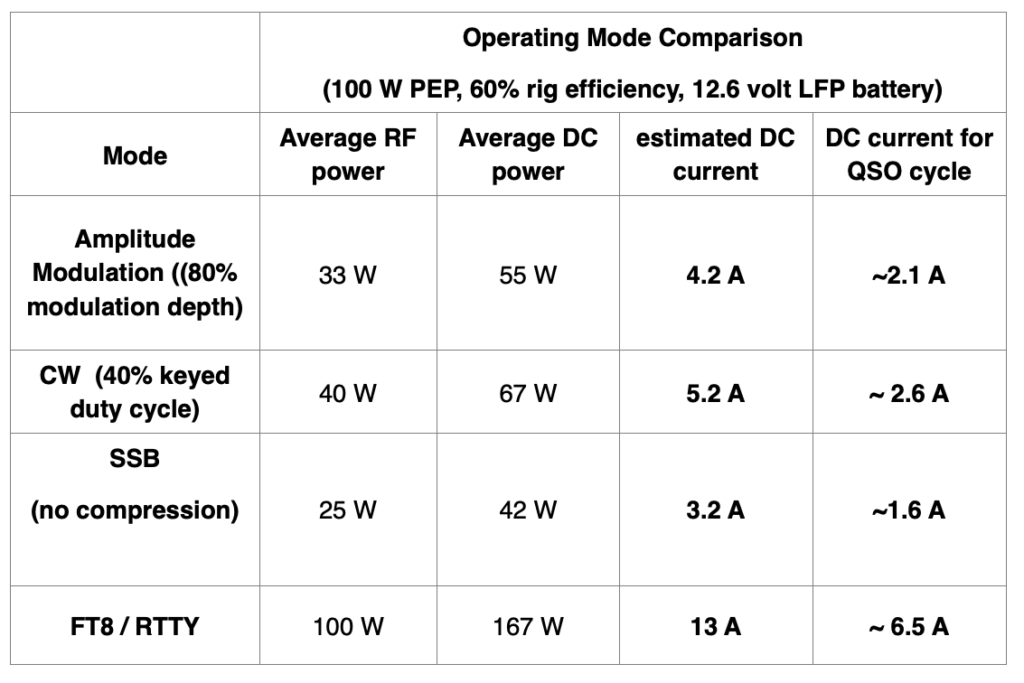
Let’s say you’re running SSB, the most energy efficient mode, and you plan run for the entire day, with a few breaks. That might mean your good for about 5 hours working stations until it’s time to pack up and go home. Looking up the current draw in the table you’ll see that total amp-hours for that use case is about 1.6 A x 5 hours or about 8 Amp-hours (Ah). That means a 10 Ah (about 125 Wh) LFP battery would be a good fit for the use case. A 10 Ah LFP batteries weighs about the same as a large water bottle. No need for anything bigger, just make sure it’s fully charged the night before.
A fully DC approach keeps your portable station efficient, quiet, and easy to transport and deploy.
Last Updated on 2026-07-04 by Joannadanna